Most people booking entertainment for a company event have only ever seen a live band from the other side of the room — at a wedding, a festival, or a bar on a Friday night. Standing on the planning side for the first time feels different. You're signing a contract for something you can't test-drive, in front of an audience of colleagues, clients, and leadership, with a budget you have to justify. The natural question isn't “which act?” It's the quieter one underneath: what is this actually going to be like?
This guide answers that question plainly. Not the sales version — the realistic one. Here is what professional corporate event entertainment looks like from the first conversation through the last song, what a good act delivers, what it asks of you in return, and where the real risks sit. If you're still weighing the format itself, our band-versus-DJ-versus-hybrid breakdown covers that decision; this piece assumes you've roughly decided and want to know what comes next.
What “live music entertainment” actually covers
The phrase hides a wide range. At one end is a single musician — a solo guitarist, a pianist, a violinist, a vocalist with a backing track — providing texture during a reception. At the other is a full ten-piece party band with horns, multiple vocalists, and a stage presence built to command a ballroom. In between sit jazz trios, neo-soul quartets, Latin and reggae ensembles, and hybrid setups where a DJ anchors the night and a live instrumentalist sits in over the top during peak moments.
Knowing where on that spectrum your event lands matters more than the genre. A four-piece reads as polished and contained; a horn-driven ensemble reads as investment and occasion. Our band roster runs 44 acts updated for 2026, spanning pop, rock, Top 40, jazz, neo-soul, country, reggae, R&B, funk, and Latin — and our wider roster of 100+ artists includes solo musicians and DJs for the moments a full band would overpower. Every act is pre-vetted for musicianship, professionalism, and range before it ever reaches a corporate stage.
What a professional act delivers on the day
The performance is the visible part. The professionalism is what you actually pay for, and most of it happens before a single note is played.
- Early load-in and setup. A full band arrives hours before doors, not minutes. They load in gear, set the stage, run cables, and stay out of your guests' way. Expect the room to look finished well before anyone walks in.
- A real sound check. Levels get set against the actual room — its ceiling height, its hard surfaces, its size — not guessed at. This is also when the act coordinates with whoever is running the program so microphones and music don't collide during speeches.
- Appropriate dress and conduct. Corporate-experienced performers show up dressed for a business audience and behave like part of your team for the night, not like a bar act that wandered in. That distinction is invisible when it goes right and glaring when it goes wrong.
- Set structure built around your agenda. A professional act plans its sets around your timeline — quieter during arrival and dinner, building toward the dance floor — rather than playing a fixed setlist regardless of what the room is doing.
What the music sounds like — and how loud
First-time bookers worry about two things: volume and gaps. Both are manageable, and both are reasonable to raise before you sign.
On volume: a good corporate act controls dynamics on purpose. During arrival and dinner, music should sit under conversation — guests should be able to talk across a table without raising their voices. After the formal program, when the goal shifts to energy, the level comes up. If your event has a heavy speaking program, say so early; the act will plan softer, instrumental-leaning material for those windows and keep the system clear of the podium mic.
On gaps: live musicians take breaks — typically the set runs in blocks with short pauses between them. A professional act bridges those breaks so the room never goes silent, usually with curated recorded music through the same system. If a continuous, never-quiet soundscape matters more than live performance for part of the night, that's often a job for playlist curation — purpose-built music programming for the hospitality moments around the main event.
How live acts read and adapt to a corporate room
The single biggest difference between an experienced corporate performer and a talented amateur is the ability to read a room and adjust in real time. A corporate crowd is not a wedding crowd or a club crowd. People are there partly for work; energy builds slowly, and it can collapse fast if the music gets ahead of the room.
In practice that means watching when guests sit down and easing off, recognizing when a table is ready to dance and meeting it, taking a reasonable request without derailing the set, and handing the room cleanly back to a speaker when the program calls for it. You should expect a corporate act to function as a quiet co-host for the evening, not just a jukebox in the corner.
What the act needs from you
Expectations run both directions. The smoothest corporate events are the ones where the host gave the act what it needed to succeed. A professional booking partner will ask for these; if no one asks, that itself is a warning sign.
- Adequate space and a stable surface. A full band needs real stage depth, not a sliver of floor. Solo and small acts need far less, but they still need somewhere defined to set up.
- Clean, sufficient power. Bands and sound systems draw more than a single household circuit. For outdoor or non-traditional venues, power is one of the first things to confirm.
- A run-of-show. A simple timeline — arrival, dinner, speeches, awards, dance — lets the act plan its sets and its volume around your evening instead of reacting to it.
- A short brand and tone brief. What is the night celebrating? Who is the room? What should guests be saying about it afterward? Two or three sentences shape the whole musical program.
- A green room or holding area. Somewhere for the act to wait during breaks and before the show keeps the performance area looking finished and the performers fresh.
How production shapes what you actually experience
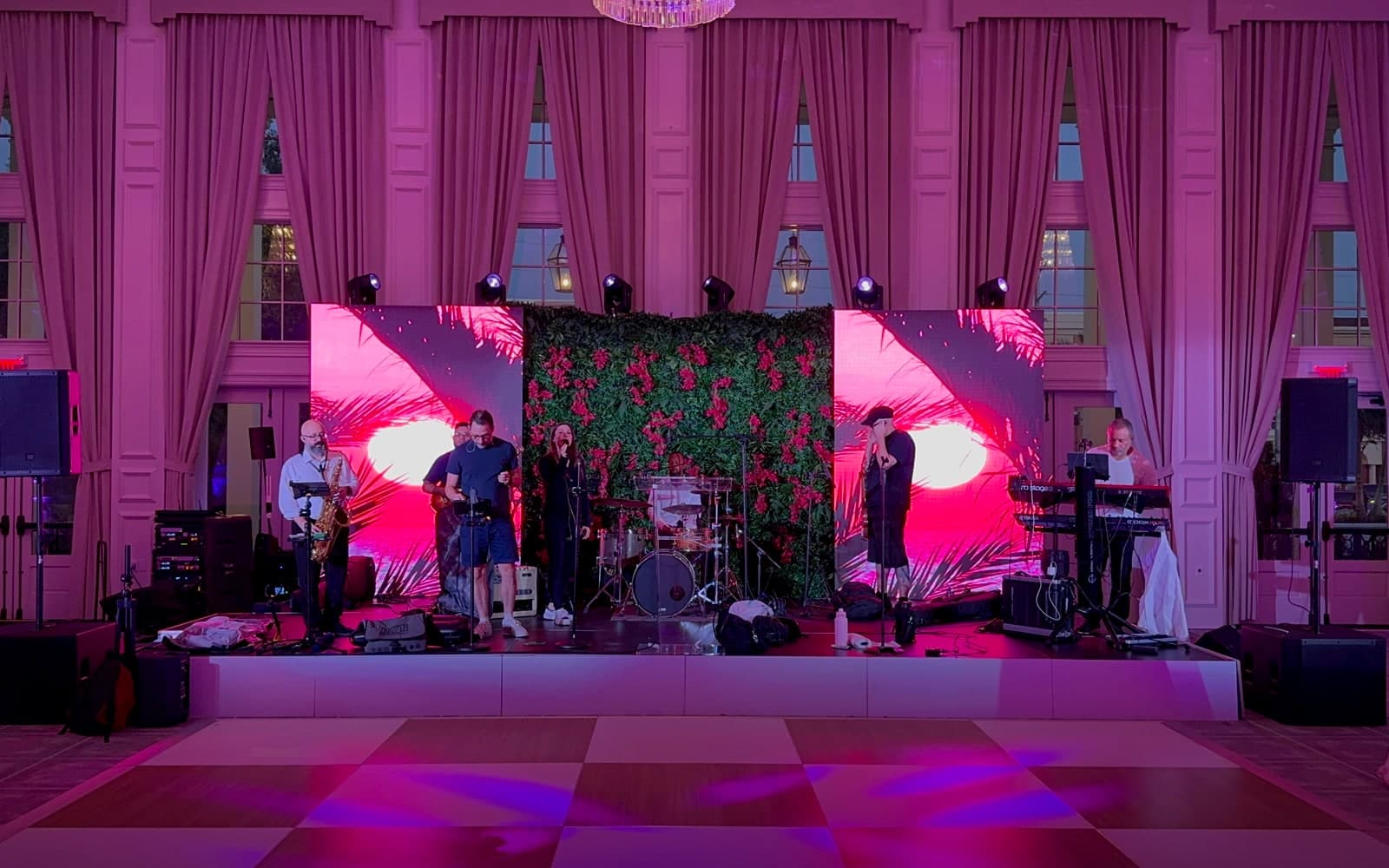
A great act under a flat house PA and a single overhead light will always underperform an average act with proper sound and lighting. That isn't a knock on the musicians — it's how rooms read light and sound. Much of what guests later describe as “an incredible band” was really the band plus the production wrapped around them.
For corporate evenings tied to a brand moment, expect the conversation to cover staging, lighting design, audio engineering, LED, and on-site coordination alongside the act itself. We handle entertainment and corporate event production under one roof for exactly this reason: the artist and the environment arrive as a single rehearsed package, with one point of contact and no vendor hand-offs to fall through. If you want the fuller picture of what that envelope includes, our guide to full-service event production walks through it.
What can go wrong — and what a good partner does about it
An honest answer to “what should I expect?” includes the things that occasionally don't go to plan. A performer falls ill. Gear fails. Florida weather rolls in over an outdoor reception. The difference between a stressful night and an invisible save is whether the people you booked planned for it.
Reasonable questions to ask before you sign: Who from your team is on-site the day of the event, and what are they responsible for? What is the plan if a key performer can't make it? Is the act booked directly through you, or subcontracted — and who is accountable if something slips? A booking partner that has been doing this since 2020, holds a Florida talent agency license, and works behind Fortune 500 activations, hotel residencies, and municipal festivals should be able to answer all three without hesitation.
Frequently asked questions
How far in advance should we book corporate entertainment?
For the dense October-through-December season, six to nine months out gives you first pick of the strongest acts and crews. For winter and spring kickoffs and galas, three to six months is workable. Less than a month out, you trade options for availability — but it's rarely too late to start the conversation.
Will a live band be too loud for speeches and networking?
Not with an experienced corporate act. Volume is controlled on purpose: soft and instrumental-leaning during arrival, dinner, and the speaking program, then building for the dance floor afterward. Share your agenda and the act plans around it.
What happens during the band's breaks?
The room doesn't go silent. A professional act bridges set breaks with curated recorded music through the same system, so the energy and atmosphere carry through until the next live block.
Do we need a band, or would a DJ or solo musician fit better?
It depends on the room, the agenda, and the moment you're trying to create. Program-heavy evenings often lean on a DJ; receptions and recognition nights reward a live band; smaller and quieter moments suit a solo musician. Our format comparison works through the trade-offs.
What do you need from us to plan the entertainment?
Three things get you most of the way: the date and venue, a rough run-of-show, and a sentence or two on what the night is celebrating and what you want guests saying afterward. From there we respond promptly with a plan.
Where to start
The fastest path from question to confidence is a short conversation. Bring your date and venue, a rough agenda, and the outcome the evening needs to support; we'll come back promptly with one or two concrete recommendations and the production envelope each would need to land well.
Reach our booking team at Booking@bookmusicbureau.com, call (813) 616-1707, or start a corporate booking brief. If you want to size the rest of the evening first, our corporate planner's playbook and FAQs cover the rest of the planning picture.