Most couples remember their wedding DJ for one of two reasons: the dance floor never emptied, or it emptied at nine-thirty and never came back. The difference rarely comes down to the song list. It comes down to how the DJ was chosen, how well they were briefed, and whether anyone planned for the venue they were walking into. This guide covers all three, so you can hire a Tampa wedding DJ with confidence, whether you're getting married in a downtown Tampa ballroom, on the sand in St. Pete Beach, or on a Clearwater waterfront lawn.
It's written for engaged couples and the wedding planners who work alongside them. We're writing it as a team of working musicians and talent buyers who book pre-vetted DJs, bands, and musicians across Tampa Bay. Here is what we look for, what we ask, and what we plan for before a DJ ever plays at one of our weddings.
What a great Tampa wedding DJ actually does all night
“Plays music” undersells the job. At a wedding, your DJ is doing four jobs at once, and a gap in any one of them shows:
- Music programmer. Building the arc of the night, from a relaxed cocktail hour to a dinner set that lets people talk to a dance floor that peaks when you want it to. Reading the room and changing course when a song isn't landing.
- Master of ceremonies. Introductions, the grand entrance, toasts, the cake cutting, last call, the send-off. The MC sets the tone of the room as much as the music does.
- Sound engineer. Making sure the officiant can be heard over a sea breeze, the best man's mic doesn't squeal with feedback, and dinner music stays at a volume where the grandparents can talk.
- Timeline partner. Working with your planner or venue coordinator to keep the evening on schedule, and knowing when to stretch a set or pull a moment forward.
When you compare DJs, compare all four jobs. A great mix on a promo video tells you about the first one only.
Map your wedding night before you compare DJs
The fastest way to get useful answers from a DJ is to arrive with the shape of your day. You don't need a final timeline, just the moments and where they happen. Here is a simple map to start from.
| Moment | What the DJ handles | What you decide |
|---|---|---|
| Ceremony | Prelude music, processional and recessional cues, microphones for the officiant, readers, and vows | Processional and recessional songs; whether live music plays the ceremony instead |
| Cocktail hour | Background music at conversation volume, often in a different space from the reception | The mood: relaxed, upbeat, or a specific genre or era |
| Grand entrance | Announcing the wedding party and the couple; cueing entrance songs; lighting cues if there is production | Entrance songs, names, and pronunciations |
| Dinner and toasts | Dinner music that leaves room for conversation; handheld mics for toasts; keeping speeches on schedule | The order of speakers and any time limits |
| First dance and family dances | Clean song starts and fades, edits if a song runs long, coordination with the photographer | The songs, and any edits or medleys you want |
| Open dancing | Reading the crowd, building energy, handling requests, working within the venue's volume limits | Must-play and do-not-play lists, and how open you are to requests |
| Last dance and send-off | Timing the final song to the venue's end time; announcing the exit | The last song and the send-off plan |
Notice how many of those moments involve a microphone, a cue, or a handoff rather than a song. That is why the next section is about questions, not playlists. For more on the arc itself, our guide to professional music programming for weddings and galas goes deeper on pacing and energy.
Questions to ask a wedding DJ in Tampa Bay, and what good answers sound like
Every vendor will tell you they're experienced. These questions get past that quickly. They reflect the standard we hold our DJ roster to: every act on it has been auditioned and cleared for professional work by our team.
1. Can we see you work a real wedding?
A club mix shows taste. Footage from an actual reception shows how they handle a mixed-age crowd, how they sound on the microphone, and how they move from dinner into dancing. Ask for video from a real wedding, not just a highlight reel. Every DJ on our roster has a profile with audio, video, and photos, and we can send more on request.
2. Who exactly will be behind the booth?
Some companies sell under one name and send whichever DJ is free that night. Make sure the DJ you met is the DJ named in your contract.
3. How do you handle MC duties?
Ask them to describe their microphone style in a sentence. Some couples want a polished, minimal host who speaks only when needed; others want someone who gets the room going. Neither is wrong, but a mismatch is one of the quickest ways for a reception to feel off. Good answers mention preparing names and pronunciations in advance and coordinating every announcement with the planner.
4. How do you handle requests and a do-not-play list?
You want a DJ who respects a do-not-play list without exception and takes guest requests with judgment, playing the ones that fit the moment rather than every one that comes up to the booth. A DJ who needs a 150-song script from you isn't reading the room. A DJ who won't look at your list isn't listening.
5. How will you cover the ceremony, cocktail hour, and reception?
Many Tampa Bay weddings use two or three spaces: a ceremony on the lawn or the beach, cocktails on a terrace, and dinner in a ballroom or under a tent. Ask how they cover each space, whether that means a second system or a fast move between rooms, and what wireless microphones they bring for the officiant, readers, and toasts.
6. What is your backup plan?
Two parts: equipment and people. Ask what spare equipment they bring and what happens if something fails mid-set. Then ask what happens if they get sick. When you book through The Music Bureau, a standby roster is kept for every booking, and if an artist becomes unavailable we send a qualified replacement at no additional cost.
7. Can you provide a certificate of insurance?
Many venues require vendors to carry insurance and to send a certificate of insurance before load-in. Ask now, not the week of the wedding. The Music Bureau is licensed, bonded, and insured in Florida, and we issue certificates to your venue on request.
8. What will the contract spell out?
At minimum: performance times, setup and load-in windows, the equipment being provided, payment terms, the cancellation policy, and a named point of contact. If any of those are missing, ask why.
How Tampa Bay venues and Florida weather change the DJ's job
A DJ who is great in a nightclub can still struggle at a wedding on the water. Weddings here come with their own conditions, and your DJ should ask about them before you ask them. Here is what we plan for:
- Outdoor ceremonies. Waterfront lawns and beaches often have a steady breeze that carries voices away and pushes wind noise into microphones. Plan wind protection for the mics and place the speakers so guests in the back row can hear the vows.
- Heat, sun, and sudden rain. DJ gear is electronic equipment. Outdoor setups need shade, a covered position, and a clear call time for moving inside if a storm builds. Florida weather can change quickly, so make that decision ahead of time.
- Power. Lawns, beaches, and tented sites don't always have outlets where the DJ needs them. Confirm power at each position with the venue, or plan for it as part of production.
- Volume limits and end times. Many venues, especially near hotels and homes, set sound limits and hard end times. These vary by venue, so get them in writing early. A skilled DJ can keep a dance floor full within a limit; the job is choosing the right songs, not turning the volume up.
- Load-in and ballroom logistics. Hotels and large venues usually set load-in windows and routes. The DJ needs those details, plus the name of the venue contact, well before the day.
Our Tampa Bay venue guide explains how waterfront, ballroom, and outdoor rooms behave, and our guide to outdoor lighting and AV in Florida weather covers rain calls and power planning in more depth.
DJ, band, or both: where a wedding DJ fits your night
If you're still deciding between formats, our guide to choosing between a live band or DJ walks through the trade-offs, and our Tampa Bay wedding band guide covers the band side. The short version: you don't always have to choose. Combinations that work well at Tampa Bay weddings include:
- Live ceremony, DJ reception. A violinist, guitarist, or small ensemble from our musicians roster for the ceremony and cocktail hour, then a DJ takes over for the reception.
- Band and DJ together. A wedding band for the peak dancing sets, with a DJ covering the breaks and the late set so the energy never drops.
- A vinyl DJ for the early hours. An all-vinyl selector for cocktails and dinner adds texture and a sense of occasion. Our all-vinyl DJ guide explains when that works.
Whatever the combination, the handoffs need a plan: who plays when, whose sound system carries the microphones, and how the music changes over without a gap. When everyone is booked through one team, that plan is made by one team.
“The best wedding DJs aren't playing for the room they expected. They're playing for the room in front of them.”
Lighting and production beyond the DJ booth
For many smaller receptions, the DJ's own sound and a little dance-floor lighting is all you need. Larger receptions, outdoor sites, and couples who want a particular look call for production planned on purpose. Common additions:
- Uplighting to warm up a ballroom or set a color palette.
- Dance-floor and first-dance lighting that drops the room to a spotlight for the moments you'll photograph most.
- A larger sound system for big guest counts or open outdoor spaces, where a single pair of speakers won't reach the back tables evenly.
- Effects such as cold sparks, haze, or LED visuals for a grand entrance or the last chorus of the first dance. Our cold sparks guide covers what venues usually ask for.
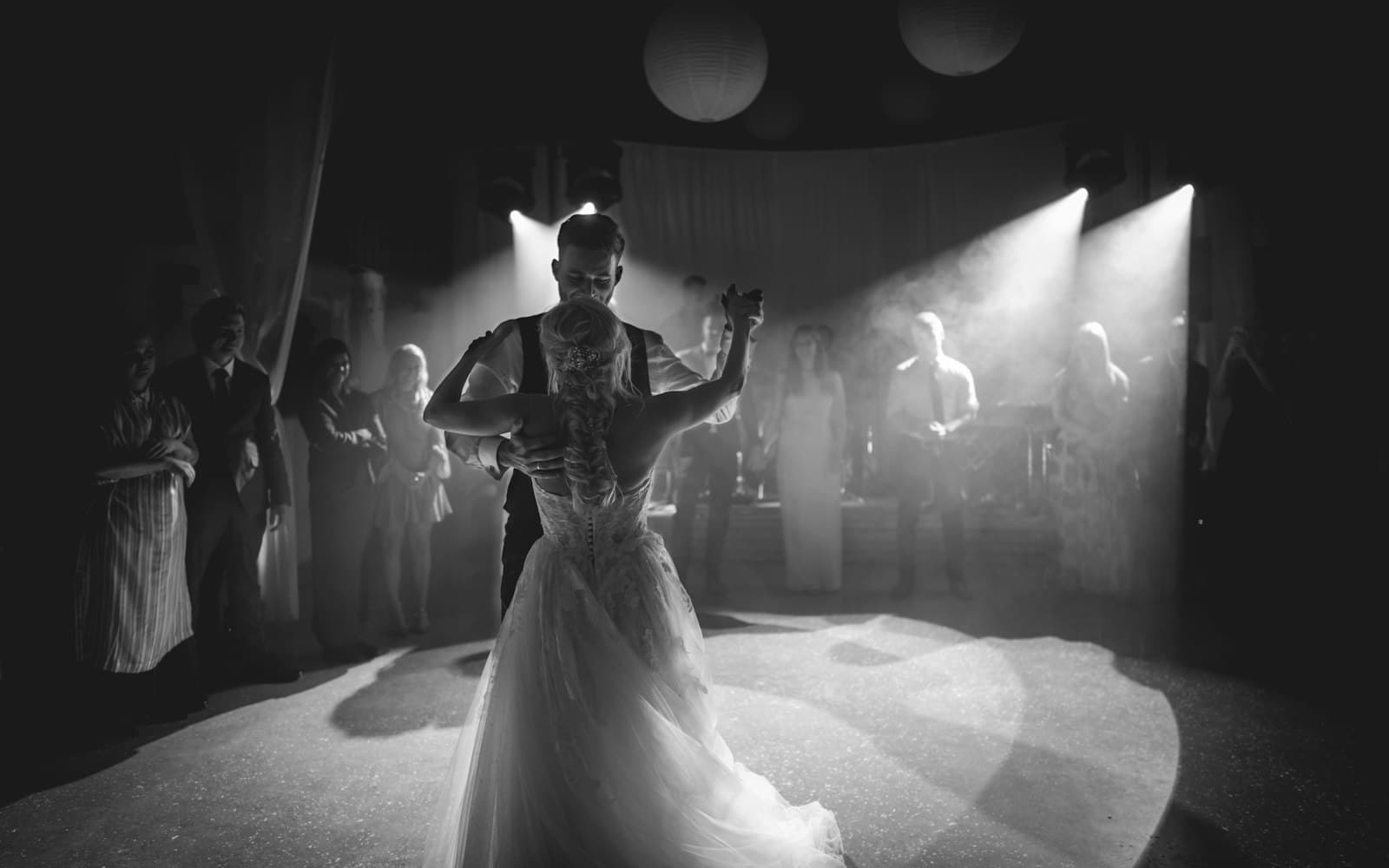
Our event production team handles sound, staging, lighting, LED visuals, lasers, cold sparks, backline, and day-of coordination, so the DJ, the lighting, and the timeline are run by the same team. For the bigger picture, see what full-service event production really includes.
What drives the cost of a Tampa wedding DJ
We don't publish flat prices, because two Saturday weddings in Tampa Bay can need very different setups. What actually moves the number:
- Hours of coverage. Reception only, or ceremony through send-off.
- Number of spaces. A ceremony, cocktail hour, and reception in three places can mean a second system or extra crew.
- Guest count and room size. These set how much sound you need.
- Lighting and production. Uplighting, dance-floor lighting, and effects are added on top of the DJ.
- Live musicians. Adding a ceremony musician or a band changes both the bill and the sound plan.
- Location. Within the Tampa Bay core, travel is built into our quotes. For destination and out-of-market weddings, travel and lodging are itemized so nothing is a surprise.
When you compare quotes, compare what is included, not just the total. A low quote that leaves out ceremony microphones or a second system will cost you more on the day.
When to book a wedding DJ, and what to send them
For weddings, booking four to nine months out gives you the widest choice of DJs. Short-notice bookings can work, but the options narrow as the date gets closer. For your first conversation, have these ready:
- Your date, and the venue or venues you're considering
- An approximate guest count
- Where the ceremony, cocktail hour, and reception will happen
- Three songs you love and three you never want to hear, which tell a DJ more than a genre list does
- Your planner's or venue coordinator's contact details
Closer to the date, we send a pre-event questionnaire four to six weeks out. It captures your final guest count, venue contact and load-in details, the timeline, must-play and do-not-play lists, and every introduction, dedication, or announcement you want the MC to make, all in one place.
Your Tampa wedding DJ checklist
- Have you seen the DJ work a real wedding, on video or in person?
- Is the DJ you met named in the contract?
- Do you like how they sound on the microphone?
- Do they have a plan for each space: ceremony, cocktails, and reception?
- Are wireless mics for the officiant, vows, and toasts included?
- For outdoor moments: is there shade, cover, power, and a rain call time?
- Do you know the venue's volume limit and end time?
- Has the venue received a certificate of insurance?
- Is there a backup plan for equipment and for the DJ themselves?
- Have you sent your must-play list, do-not-play list, and announcement names?
Book your Tampa wedding DJ with The Music Bureau
The Music Bureau is a Tampa-based entertainment and event production agency built by experienced musicians and talent buyers. We book pre-vetted DJs, bands, and musicians for weddings across Tampa, St. Petersburg, Clearwater, and the rest of Florida, and we handle the production around them, from ceremony sound to the final song. We're licensed, bonded, and insured in Florida.
Tell us your date, your venue, and the kind of night you want. We'll respond promptly with Tampa wedding DJs who fit it. Visit our contact page, email Booking@bookmusicbureau.com, or call (813) 616-1707. Mail reaches us at PO Box 272853, Tampa, FL 33688.
Frequently asked questions
How far in advance should we book a wedding DJ in Tampa?
For weddings, booking four to nine months out gives you the widest choice of DJs. Shorter notice can work, but the options narrow as the date gets closer, especially on popular Saturdays.
Can our wedding DJ also be our MC?
Usually, yes. Most wedding DJs handle the announcements, introductions, and transitions as well as the music. Ask to hear how they speak on a microphone, agree on the tone you want, and give them the exact names and pronunciations for every introduction.
Do we need a separate sound system for an outdoor ceremony in Tampa Bay?
If the ceremony is in a different spot from the reception, usually yes. A small, separate system with wireless microphones for the officiant, readers, and vows makes sure guests can hear. On waterfront and open-lawn sites, wind and power access matter, so the DJ should see the site plan in advance.
Can we give our DJ a must-play and do-not-play list?
Yes, and you should. A short must-play list, a clear do-not-play list, and a few songs that capture your taste give a good DJ everything they need. Leave room for them to read the crowd rather than scripting every song.
What happens if our DJ gets sick before the wedding?
Ask every DJ this before you book. When you book through The Music Bureau, a standby roster is kept for every booking, and if an artist becomes unavailable a qualified replacement is sent at no additional cost.
Can we have a DJ and live music at the same wedding?
Yes. A solo musician or small ensemble for the ceremony and cocktail hour, followed by a DJ for the reception, is a common setup. The handoffs between them need to be planned so the night feels continuous.